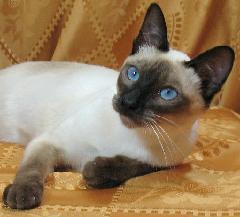
One of us at Sarsenstone
is an epidemiologist, a researcher who specializes in disease
prevention and control, so we can't resist
talking a little about how to prevent and control feline infectious
peritonitis, FIP. We also encourage you to ask your veterinarian any
questions you may have about FIP.
When
you look at cattery ads and websites, you often see "We guarantee our
kittens free of feline leukemia and FIV." Sometimes you see guarantees
that kittens are free of ringworm and FIP, as well.
It
is reasonable for a breeder to claim that her kittens are free of
feline leukemia and FIV. There are good screening tests for those
diseases. The tests are not perfect. No test is. But they are very,
very good, about as good as screening tests can get. If a breeder tests
all new cats for feline leukemia and FIV and does not allow the new
cats to join her other cats
until she is sure they are negative for those diseases, and if she
never
allows her cats to wander outdoors, she can be confident, and so can
you,
that her kittens are leukemia and FIV-free.
Ringworm is more problematic. A breeder can reduce the risk of
ringworm, but cannot absolutely guarantee her kittens will be
ringworm-free. The Wood's lamp test for ringworm is only partially
effective, and new breeding cats may carry ringworm asymptomatically
and go on to infect the kittens in
a cattery. Ringworm is particularly likely to break out if the cattery
is
located where the weather is usually both warm and damp.
In
this article, however, I am mostly going to talk about FIP. FIP should
not be confused with FIV. They are two entirely different diseases.
There is a good test for FIV, but there is no valid screening test for
FIP and no cure for the disease. FIP is nearly always fatal once
symptoms have appeared, so this is a huge concern.
Let
me say it again.
Although some breeders
advertise that they have tested their cats for FIP or that their
catteries are "FIP negative," those claims are meaningless. There is no
laboratory test that can guarantee that any cat is free of
FIP. There are several tests that have been
developed for
FIP, but so far none has proved to be even a moderately good screening
test.
In fact, the situation is so miserable that breeders can test every cat
and get negative results even in the middle of an
FIP epidemic in
the cattery.* On the other hand, cats can have high coronavirus titers
(the
coronavirus titer is one of the "tests" for FIP) when they don't have
FIP
at all but instead are only fighting a harmless coronavirus, something
that
could easily happen after a cat changes homes and encounters new but
harmless
family "bugs." FIP testing is a complex area of veterinary medicine and
not
all vets adequately keep up with developments in that area. Due to
occasional
veterinary misinterpretation of "FIP tests," some cats have been
euthanized
who had temporarily high but harmless coronavirus titers, cats who
otherwise
might have lived long healthy lives.
So
how can you tell whether the risk of FIP is low in a cattery? Well,
mainly by how clean it is, how happy the cats are, and how uncrowded
the cattery is. Having an uncrowded cattery with happy, unstressed cats
is very, very important. Breeders can use good cattery management to
reduce the risk of FIP. A cattery that is at low risk for FIP is one
that has
only a few felines, especially young felines, on the premises at any
given
time. The fewer, the better. There are reputable breeders who breed
more
than a few litters per year and have excellent reasons for doing so,
but
the fact is, the more adult cats are housed together and the more
litters
are bred on the same premises in a given year, the higher the risk of
FIP.**
The
bug that causes FIP is one type of coronavirus from a family of
hundreds of harmless coronaviruses. The harmless coronaviruses, the
ones that do not cause FIP, are common as dirt, and research has shown
that in a multi-cat home they are nearly always present. Unfortunately,
it
appears that at any given moment a harmless coronavirus may mutate into
a
dangerous FIP virus. Currently, it is not possible to eliminate all
types of coronaviruses. That would be like trying to keep every mote of
dust out
of a home, just not practical. FIP can therefore develop in any cat in
any
home. In one published case, a pet cat living strictly indoors by
himself for eleven years developed FIP.
Fortunately, FIP does not
often develop in adult cats. FIP most often strikes at age 6 to 8
months, and it strikes somewhat often in kittens up to 1 1/2 years old.
Kittens are much more likely to develop FIP than
adults because kittens have immature immune systems (especially when
they
are less than a year old). No one knows for certain why the big older
kittens
develop FIP more often than the young babies, but it may be that FIP is
a complex disease that takes a long time to develop. It starts in very
young kittens, but the first symptoms are not seen until the kitten is
much older.
According to one
recent estimate, even very well run catteries and
shelters may have something like 2 percent of their kittens develop
FIP,
and virtually all of them that do will die of the disease. To put it
another
way, it's virtually impossible to rescue cats or breed cats for any
length
of time without eventually encountering FIP. Cases tend to occur in
clusters.
That is, the cattery or shelter may go for several years without a
single
case of FIP, then begin to have cases occur regularly, and finally FIP
stops
appearing for another few years.
Whether
or not a kitten gets FIP seems to depend primarily on two things: (1)
stress and (2) genetics.
To
put it another way, the development of FIP depends on the strength of
the feline immune system. Stress impairs the immune system in most
animals and in humans. Very young cats under stress are more vulnerable
to FIP
than other cats. Veterinary researchers have noticed that FIP
frequently strikes after a stressful event, such as changing homes,
declaw surgery, or after a period when the cat's beloved owner was out
of town.
Cats
that have inherited weak immune systems are also vulnerable to FIP. In
fact, researchers estimate that genetic factors account for
about 50 percent of the risk of FIP. Although the amount of inbreeding
in a cat's pedigree did not seem to predict FIP in one study, that may
be because of the study's limitations. In epidemiologic studies, the
ability
to detect the cause of a disease will in part depend on how much
variation
in exposure there is in the population studied. In plain English, if
you
study a group of pedigreed cats, all of whom are actually fairly
inbred, they may not be different enough from each other for
researchers
to detect a significant genetic difference in their risk of FIP. It can
appear as if genes don't matter when in fact they do.
This kind of research
limitation is particularly likely if a genetic predisposition to FIP is
the result of dozens of genes (polygenes).
Experimental
evidence points to the importance of genes in designing the
feline immune system and thereby affecting vulnerability to FIP. In one
study, for example, the ability of each cat to produce
interferon gamma seemed to determine whether the cat did or did not
come
down with FIP symptoms and die. Interferon gamma is one of the tools
the
immune system needs to fight certain types of disease.
At
Sarsenstone Cattery, we think the evidence is strong enough to take
seriously. We have always had an extraordinarily low incidence of
FIP in our cats. In fact, we have never had a case of FIP occur in cats
or kittens living with us, including no unexplained deaths of cats or
kittens, and we only once in the history of our cattery have ever had a
kitten develop FIP after leaving us. That particular kitten developed
FIP about 8 months after he left, at age 11 months old. He was from the
only litter we've ever produced that had somewhat closely related
parents. The mother of the kitten was the half niece of the father;
that is, the maternal grandmother of
the kitten was the half sister of the kitten's father. Perhaps that was
just bad luck, just random chance. Or perhaps it was the shared genes
the
parents had that caused their kitten, just the one kitten out of a
litter
of five, to have a weaker immune system and be more vulnerable to FIP
than
our other kittens.
We will never know for
sure. We neutered the father of the kitten; he never sired another
litter. The mother of the kitten had many litters with other studs and
never had any other offspring come down with FIP.
But
it is just one more reason, out of hundreds of other reasons, to avoid
breeding closely related cats and, indeed, to actively search for and
import fresh bloodlines to expand the gene pool of our cattery and
of the breed as a whole.
For
those of you who are looking for a purebred kitten or cat to join your
family, the bottom line is simple. If a breeder breeds long enough,
sooner or later that breeder will encounter a case of FIP in the
cattery. It's not a question of if; it's a question of when. Good
breeders can't completely prevent FIP. There is no such thing as an
"FIP-negative cattery." But breeders can make FIP a rare event via wise
cattery
management.
Remember: There is no reliable test
for FIP. However, you can evaluate risk by looking at cattery
conditions. Breeders with multiple litters perpetually present and
large numbers of cats crowded together have a high-risk
situation. A breeder with very few adult cats, who raises only a few
litters per year, and who keeps the premises immaculate and the cats
well fed and uncrowded and happy, has the lowest possible
risk of FIP. §
For
more
information about FIP, we encourage you to visit the SOCKFIP website
(click logo below),
where you can learn about the latest research at the University of
California at Davis and the war the cat fancy is waging against
FIP. You may also want to consult
the excellent
article by Dr. Susan Little, a veterinarian who specializes
in cats and who also had breeding experience when she was younger. She
knows more than most vets about the theory and practical issues
surrounding prevention of FIP .