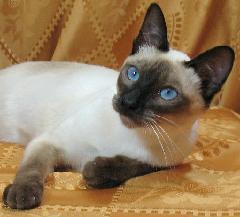
Most kittens at
Sarsenstone Cattery are seal points and blue points.
For general information
about the quality of Siamese color and pattern, see below.
|
Hind
quarters of two Siamese cats lying side by side. The one at right is
much darker than
the other and has undesirable barring and shading. |
When referring to a
Siamese, the word "color" refers to the color of the darkest fur on the
cat. "Seal" is the most common of the many possible Siamese colors. It
is a dark brown that is almost black.
Pattern
refers to the distribution of color on a cat. Siamese have the
"colorpoint" pattern, which means the color on the body is of a lighter
shade than the color on the "points": the face, ears, tail, and paws.
Consequently,
the points of a seal point Siamese are a dark brown that is almost
black, and the rest of the body is a much, much lighter shade of seal,
which looks beige-white.
The
word "contrast" when applied to a Siamese refers to the pattern
contrast, the clear-cut difference between the darkness of the points
and the lightness of the rest of the body. "High contrast" is
considered the ideal in Siamese of all types. High contrast means that
the body
of the Siamese is markedly lighter than the points. The body is a
lighter version of the point color, but ideally it's so much lighter as
to be
almost white. The emphasis is on getting a lighter body rather than on
getting darker points. The points are supposed to be exactly a certain
color, such as dark-brown-almost-black for seal point Siamese.
Therefore, high contrast is achieved by breeding for a seal point with
exactly the
right point color and a body as close to white as possible.
In
addition to the right color and high contrast, a Siamese with good
color should have very EVEN color. There should ideally not be any sign
of stripes or blotches, not even shadowy ones, on the body of the
Siamese.
In
practice, many Siamese have color, contrast, and evenness that are far
from ideal. For example, many cats have belly spots, bars on their
legs, and even visible stripes over the rib cage. Siamese darken with
age—up to about 3 years old. By the time your kitten is mature, if he
is
a poor quality seal point, he may have body blotches. He may have a
body
so dark in some spots it may run into the point color. A large part of
the entire cat may look solid brownish black. Chocolate points are
supposed
to be a light milk chocolate color on the points, but many poor quality
chocolate points are bred that have points so dark and body color so
beige-ish
it can be very hard to tell if they are seal points or chocolate
points.
Some people work long and hard to find a chocolate point kitten to buy,
even pay extra for one, but then the kitten ends up looking just like a
seal point when he grows up. A poor quality blue point might have
points
that are a dull, unexciting gray and a body that is almost the same
color.
A poor quality lilac point may not look much different from a blue
point.
Don't
get us wrong. Whether or not a Siamese kitten has high quality color,
contrast, and evenness, he is likely to have the famous Siamese
personality and will make a wonderful pet. By the time he has wrapped
you around his charming little paws, you will be too enthralled to
notice whether he has high contrast or low contrast, great color or
poor. The health and personality of a Siamese are far more important
than color.
If
you are buying a kitten as a pet, our advice is to never, ever reject
an exceptionally bright, loving, outgoing, healthy kitten based on
cosmetic traits. Personality and, even more so, health tend to be
neglected by breeders. Most will deny that, but it quickly becomes
obvious, when talking to a large number of breeders, that many are
skilled at evaluating the appearance of Siamese cats, but they know
little about doing pedigree research, genetics, and discussing
breed-wide genetic diversity issues. So, never take health and
personality for granted.When you tell a breeder you want a "pet
quality" kitten, by definition "pet quality" means a
healthy kitten with a nice personality, not one that is cosmetically
perfect.
What
we hope you will learn from this discussion is that only novice
breeders aim for producing a large number and variety of colors.
Inexperienced and uninformed breeders talk a great deal about how many
colors they breed and not at all about how they achieve quality
in those colors. The quality of the color and pattern contrast play a
major part in making an Old-Style Siamese attractive. When breeders
want to improve the cosmetic appearance of their cats, they have their
work cut out for them breeding for quality in one
color. That is especially true when working with a rare breed in which
it is hard to find breeding cats. Breeders are therefore better off
aiming for good quality in one or two favorite colors than
they are trying to breed all the possible colors. Breeders who
specialize
in a common color, instead of trying hard to find and maintain rare
colors in the cattery, are more easily able to find breeding cats that
are healthy as well as the right color.
For a description of
what the old-Style Siamese colors should look like when they are high
quality, see the TICA Thai Breed Standard on the PREOSSIA web page. "Thai" is the name TICA
gives to the old-style Siamese.